What matters first
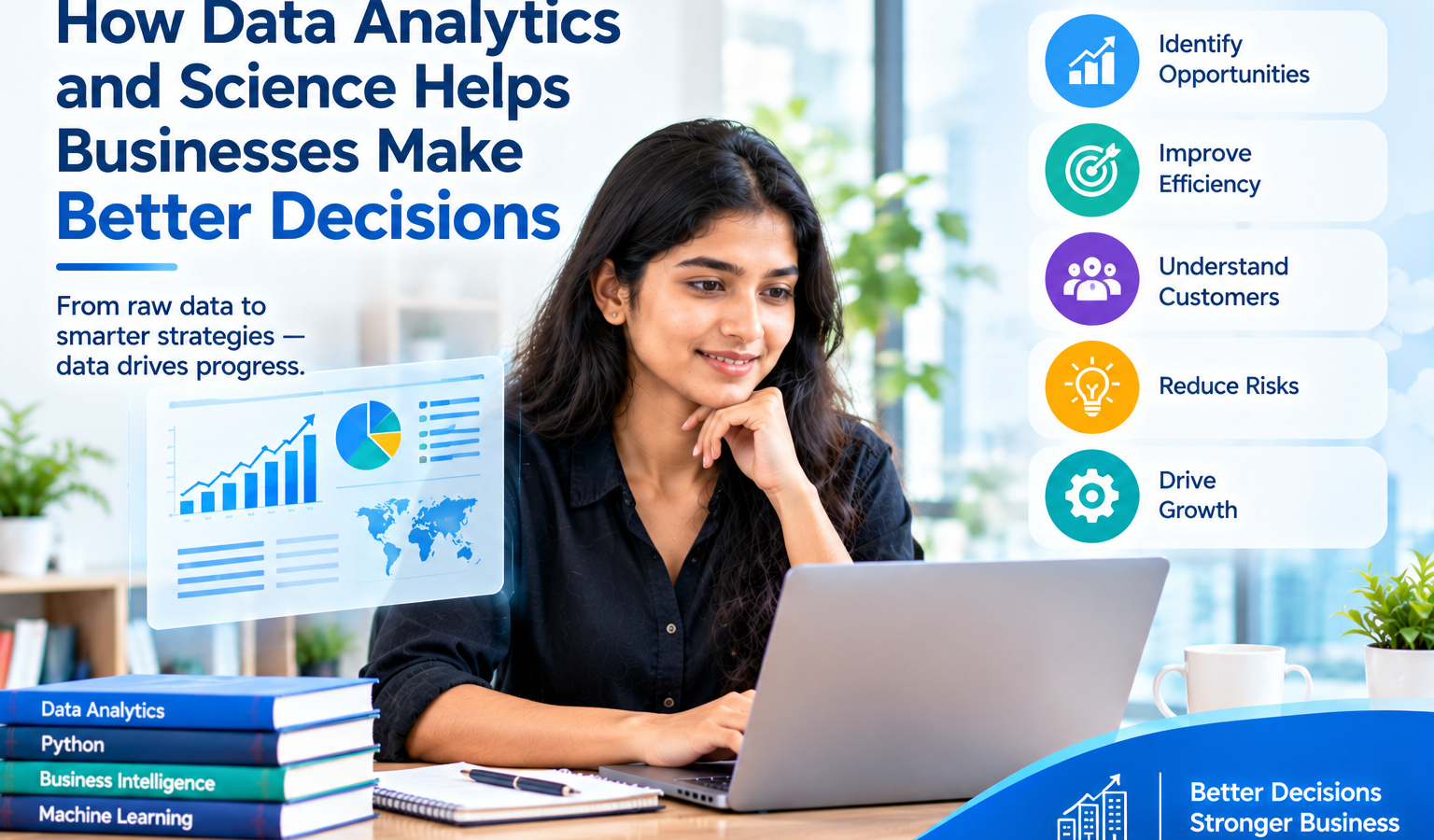
Businesses generate data through sales transactions, websites, customer interactions, marketing campaigns, supply chains and internal operations. However, collecting information alone does not automatically improve performance. Organisations need ways to interpret that information and turn it into decisions. This is where data analytics and data science training institutes in Bangalore become valuable. They help businesses understand…
Businesses generate data through sales transactions, websites, customer interactions, marketing campaigns, supply chains and internal operations. However, collecting information alone does not automatically improve performance. Organisations need ways to interpret that information and turn it into decisions.
This is where data analytics and data science training institutes in Bangalore become valuable. They help businesses understand what is happening, investigate why it is happening and, in some cases, estimate what may happen next. When used appropriately, these approaches can support more informed decisions across departments.
Understanding Data Analytics and Data Science
Data analytics involves examining data to identify patterns, measure performance and answer specific questions. For example, a retail business might analyse monthly sales to determine which products perform best during different seasons.
Data science includes a broader combination of programming, statistics, analytical methods and machine learning. It can be used to develop predictive models, automate parts of analysis and investigate more complex business problems.
The two fields overlap, but they are not identical. A business can gain substantial value from straightforward reporting and analysis without needing an advanced machine learning model for every problem.
1. Understanding Customer Behaviour
Customer preferences can change according to price, location, season, product availability and purchasing habits. Businesses that examine customer data can develop a clearer understanding of these changes.
For example, an online retailer may analyse purchase history, product views and repeat orders to identify popular categories. The findings can help the company improve product recommendations, plan promotions and make its website easier to navigate.
Customer segmentation is another useful application. By grouping customers according to relevant characteristics or behaviour, businesses can adapt their communication and services to different needs.
These insights must be handled responsibly. Companies should respect privacy requirements, use appropriate permissions and avoid making unfair assumptions about individuals based on incomplete data.
2. Improving Sales and Revenue Planning
Sales teams often work with historical transactions, lead records and conversion rates. Analysing these measures can help managers understand where revenue comes from and where potential opportunities may exist.
Consider a company whose sales have declined over three months. A basic analysis might compare performance by product, region, sales representative and customer segment. This could reveal that the decline is concentrated in one region or product category rather than affecting the entire business.
Data science techniques may support more advanced forecasting when suitable historical information is available. Nevertheless, forecasts are estimates, not guarantees. Unexpected market changes, pricing decisions and supply disruptions can affect actual results.
The goal is to improve planning by combining analytical evidence with business experience.
3. Making Marketing Campaigns More Effective
Marketing teams need to understand which activities attract relevant visitors and generate meaningful outcomes. Analytics can help measure website traffic, campaign engagement, lead quality, conversion rates and customer acquisition costs.
For example, a business running multiple digital campaigns can compare the number of leads generated with the number that eventually become customers. This is more informative than evaluating campaigns solely by clicks or impressions.
A campaign that generates many enquiries may still perform poorly if those enquiries do not match the intended audience. Analysing the complete journey helps marketers allocate budgets more carefully and identify where improvements are needed.
Businesses should also avoid assuming that a correlation proves causation. A campaign may coincide with higher sales without being the only reason for the increase.
4. Optimising Inventory and Operations
Retailers, manufacturers and logistics companies must balance product availability against storage and operating costs. Data analytics can help identify purchasing patterns, slow-moving inventory and recurring supply problems.
For instance, a business may discover that demand for a particular product rises during specific months. It can use that information to improve procurement planning and reduce the risk of shortages.
Operational analytics can also reveal bottlenecks. If orders regularly take longer to process at one stage, managers can investigate staffing, equipment, workflow or system constraints.
These improvements can be particularly useful when businesses monitor their performance consistently rather than relying on occasional reports.
5. Supporting Financial Planning and Risk Management
Finance teams use data to track revenue, expenditure, profitability and cash flow. Comparing actual performance with budgets helps organisations identify unexpected costs and adjust their plans.
In financial services, more advanced analytical methods can support fraud detection and risk assessment. Models may identify transactions that differ from established patterns, allowing teams to investigate suspicious activity.
However, an unusual transaction is not automatically fraudulent. Analytical systems should support appropriate review processes, and their results should be evaluated for errors and unintended bias.
6. Why Data Quality Matters
Reliable decisions depend on reliable information. Duplicate records, missing values, inconsistent definitions and outdated data can distort analysis.
Before creating dashboards or predictive models, organisations should establish how information is collected, cleaned, stored and maintained. They should also ensure that teams understand what each metric means.
A dashboard can appear professional while still communicating an inaccurate picture if its underlying data is incomplete. Data quality checks and clear reporting standards are therefore essential parts of any analytics initiative.
7. Building Data Skills Within an Organisation
Businesses need professionals who can work with data, interpret findings and explain their implications clearly. Relevant skills may include spreadsheets, SQL, Python, statistics, visualisation and an understanding of business processes.
Not every role requires the same level of technical expertise. Business managers may need to interpret dashboards, while analysts may need stronger querying and visualisation skills. Data scientists working on predictive modelling may require additional programming and statistical knowledge.
For people exploring these career paths, practical projects can help connect technical concepts with business problems. Training programs, including data science offerings from providers such as NUCOT, can be evaluated by examining their curriculum, practical exercises and learning support. Prospective learners should confirm the latest course details and decide whether they align with their goals.
Conclusion
Data analytics and data science can help businesses understand customers, measure marketing effectiveness, improve sales planning, manage inventory and monitor financial performance. Their value comes from answering meaningful questions not simply from producing more charts or adopting advanced technology.
Organisations should begin with a clearly defined business problem, check the quality of available data and select methods appropriate to the decision. When analytical evidence is combined with domain knowledge, responsible data practices and regular evaluation, businesses can make better-informed decisions and adapt more effectively to changing conditions.